
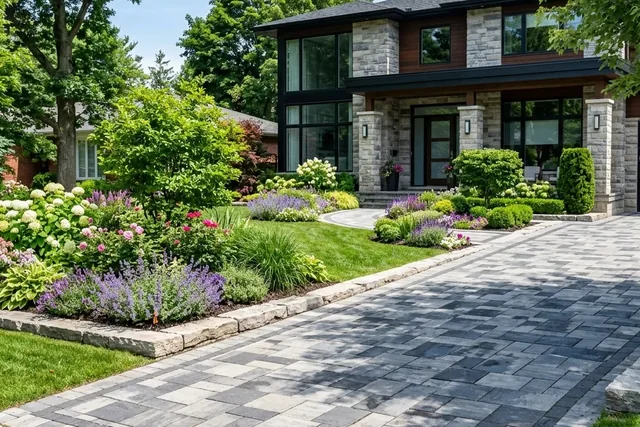
For a GTA driveway the honest answer is: both work if built properly, and they fail in completely different ways. The question is which failure you would rather live with.
How each one behaves in frost
Interlock is a flexible system. The surface is thousands of small units sitting on a compacted base, so when the ground moves, the field moves with it and comes back. When it does go wrong, individual areas can be lifted, the base corrected and the same pavers relaid.
Poured concrete is a rigid slab. It moves as one piece, and when the ground under it moves differently from one end to the other, it cracks. Control joints tell it where to crack, but they do not prevent it. Once it has cracked and settled, the fix is removal and replacement of that section — and the new pour rarely matches.
Salt
This is where concrete suffers in Ontario. De-icing salt attacks the surface, and a poorly cured or under-air-entrained slab spalls: the top few millimetres flake off and it looks tired fast. Pavers are manufactured under pressure and are generally more resistant, and where a few units do suffer they can be swapped individually.
Cost over fifteen years
Concrete is usually cheaper on day one. Interlock costs more up front and is repairable, so the fifteen-year picture often lands in its favour — assuming both were built on a proper base. Built badly, both are expensive in different ways.
Which we recommend, and when
- Interlock for most residential driveways in the GTA, especially where the surface will be plowed and salted every winter, or where you might extend or alter the layout later.
- Poured or stamped concrete where you want a continuous monolithic surface, for large simple areas away from heavy salt, or to match existing concrete work on the property.
Whichever you choose, the base under it is the same conversation. Ask for the excavation depth in writing.
Free estimate
Questions about your own property?
Call or text 647-621-8592, or send a photo and the address.